 |
| Dick Steinborn |
“You killed him! You murderer!”
These chilling words echoed in the mind of
the young man as tears rolled down his face. Just a few hours earlier he had
felt the tremendous excitement and satisfaction that one feels when realizing
the fulfillment of a lifelong dream, one that was made all the more important
by the fact that he was following in his beloved father’s footsteps. In no time
at all it seemed as if the dream had become a nightmare, one he was sure to re-live
over and over in his mind, perhaps for the rest of his life. Being only 17
years of age, it was understandably not something that young Dick Steinborn was
looking forward to.
The Strength of My Father
Born the son of legendary strongman, professional
wrestler and promoter Henry “Milo” Steinborn, Dick had loved wrestling ever
since he could remember and became quite adept at it, receiving instruction
from his father and also many of the professional wrestlers who frequented the
basement gym of his family’s home during their time living in New York.
“My dad had a stake in the New York wrestling
office along with Toots Mondt and Rudy Miller, and when I was 14 years of age,”
says Dick. “He’d always invite the boys to his gymnasium in the basement of our
apartment building in Queens,
New York. I remember that Stu
Hart was beginning to make a name for himself in New York and he’d come down to the gym on
Sundays and work out on the mat with my brother and me.”
Dick took to wrestling like a fish to
water, just as he did to almost everything he ever tried, including the 17
different sports he would involve himself with at one time or another during
his life. “My dad always said, ‘Dickie can never keep still, he’s always moving.’”
At one point Dick Steinborn was diagnosed as having Attention Deficit Disorder,
and while it was difficult at times to focus his attention, whatever did catch
his attention was something he typically excelled at. It was no different with
wrestling.
He and his brother Henry excelled in
amateur wrestling while attending Trinity
High School in New
York, enough so that the coach from Columbia University
placed them both on the school’s Junior Varsity team while the teens were still
enrolled in High School. While that was some achievement in itself, Dick, who
was easily the better athlete of the two brothers, had greater aspirations. Like
his father, he wanted to enter the ranks of professional wrestling.
Milo Steinborn, whom Lou Thesz called “The
strongest man I ever wrestled,” was admired greatly by Dick for both his
accomplishments in the ring and his character as a man. “Dad was the Babe Ruth
of the sports world for a few years,” Dick would say. The training Milo provided his son in the weight room and on the mat
made Dick’s body strong and well prepared for the physical rigors of life in
the ring, but the mental preparation would prove to have even greater value to
Dick both in the ring and out of it. “I owe him everything I have,” his son
said with appreciation. “Not just in a physical sense but also my training of
mind.”
Still a few months shy of his 18th
birthday, Dick was unable to obtain a license to wrestle as a professional in New York, but to his delight, he was able to receive both
a professional wrestler’s license and a booking in the state of Maryland. So it was with
great excitement and anticipation that Dick would board the train from Astoria, Queens to make the 175 mile trek to Baltimore. He would be
appearing in a “dark match” to precede the matches that were to be televised
from the Baltimore Coliseum.
On that special night on July 24, 1951,
for Dick, the noise of the crowd was near-deafening and the atmosphere was electric,
and despite it being his very first pro match, the match went smoothly. Approaching
the finish of the match, Dick escaped from a headlock that was applied by his
opponent Les Ruffin, by whipping him into the ropes. When Ruffin rebounded off
the ropes, Dick, who had greatly strengthened his legs with specialized
training, leapfrogged over the man (“few people were doing the leapfrog in
those days”) and as Dick reached the peak of his leap, he saw a most curious
thing.
“A shoe flew into the ring, which must’ve
been meant to strike Ruffin, who was the heel, and I watched it as it arched
like a rainbow and sailed over the both of us almost as if in slow-motion.” The shoe may have missed its mark, but Dickie
hadn’t as he had managed to secure the victory over his veteran opponent. His
first in-ring experience was a thrilling one and he enjoyed the hearty
congratulations he was receiving in the dressing room after the match. This was
something he could certainly get used to. But the mood was about to quickly
change.
Several men had suddenly burst into the
room carrying the body of a man that they then laid out on a nearby table. That
alone was an expected occurrence but there was something else that Dick found
odd.
“I noticed that the guy only had one shoe
on. And so I said to the boys, ‘Look, fellas, he must be the guy who threw the
shoe in the ring!’” The man on the table was dead, and while it was certainly
an unfortunate occurrence, like sharks smelling blood, the veteran wrestlers in
the dressing room also saw it as an opportunity for a rib and to break in the
rookie.
“’You killed him!’ says one of the boys,
and another one added, ‘you murderer!’” recalls Steinborn. “I began to think
that something I had done in the ring really did kill the guy. What those guys
didn’t realize was that I had the strength of my father, but the emotions of my
mother.”
Devastated, the 17 year-old-rookie
wrestler quickly grabbed his bag and headed for the train station. The train
ride home to New York felt much longer than
the ride into Baltimore
as his emotional anguish caused tears to stream down his face during the entire
trip back home. He had determined in his mind that his first match would be his
last.
But Milo
offered words of comfort to his son and Dick was further consoled by the fact
that no one really held him responsible for the death of the one-shoed man, and
that in fact it was the combination of the man’s pre-existing ill health and
his drunkenness that night which had caused his fatal heart attack. The
following week Dick would return to Baltimore
for yet another wrestling match and victory, and the rest as they say, is
history.
“I’ve wrestled in 44 states and 14
different countries,” says Steinborn of the career that spanned 33 years and
included over three dozen wrestling title reigns. “Wrestling’s been my
life. It’s been a love. You can’t destroy the love of a passion that
you have.”
Genius
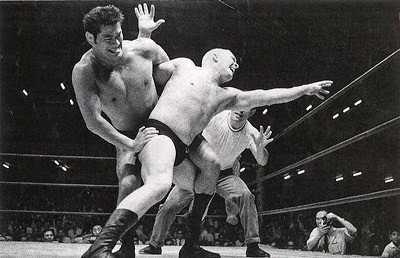 |
| VS. Antonio Inoki in Japan |
Through the years his love and passion for
professional wrestling would grow as well as his ability in the ring and his
ability to grasp the finer points of the game. While he speaks of such
wrestling bookers and promoters he worked with along the way, like Roy Shire,
Leo Garibaldi, and Tom Renesto as “geniuses”, he learned from such men and some
of the ring performers he worked with, borrowing some ideas and creating
original ones of his own, to become a master storyteller in his own right.
“One of the greatest workers I ever saw
was Dickie Steinborn in Georgia,”
recalled former wrestler Dutch Mantell. “He was the smoothest, greatest
wrestler I’ve ever seen. I remember some
of the greatest matches I ever saw were between Jody Hamilton, “the Assassin”,
and Dick Steinborn…this is when they used all the psychology, when they had the
fans standing and crying. I mean if you
watched it, you actually believed it. It
was that good.”
Jody Hamilton also fondly remembers those
matches as well, citing Steinborn as his all-time favorite opponent. “We once
did a 2 hour 45 minute match with no falls and we kept the crowd!” said Hamilton. Imagine the ability to tell a story in the
ring that would keep a crowd engrossed for nearly three hours and that ended in
a draw without a single fall being scored!
During his extensive travels as a
professional wrestler, Steinborn always remained a student of the game, despite
how much he had already come to grasp about the business. He incorporated
various styles into his ring work, adding dimension and versatility to his ring
repertoire, and he could often emulate the best moves of some of the performers
he came across.
Such was the case when he was asked in
1968 to substitute for Tim Woods as the masked Mr. Wrestling after Woods left the Georgia
territory in a dispute with the Atlanta
office. As Mr. Wrestling, Steinborn worked a match against “The Professional”
Doug Gilbert, the outcome of which saw Mr. Wrestling unmasked.
“It turned out that Mr. Wrestling had lost
the match,” recalls Ron Starr, who at 18 years of age at the time, was still a
fan, but would later go on to win more than 30 titles of his own as a
professional wrestler. “But when Mr.
Wrestling unmasked, it wasn’t Tim Woods, but Dickie Steinborn! I could’ve sworn
that it was the original Mr. Wrestling in the ring because Dickie worked the
match with the same exact style as Doug Gilbert, and I could not tell the
difference whatsoever. It was one of the greatest matches that I ever saw.”
“Be careful what you decide to do in life,
for you will succeed,” is one of Dick’s observations on life and a motto he
lives by. There is no doubting his
success in the ring and his ability to comprehend and use what it took to
emotionally suck the fans into what transpired in the “squared circle” was
recognized by his peers. This would lead to him booking angles in Puerto Rico
and Canada, as well as
promoting several towns in Georgia
for Gunkel Enterprises. Oil painting is one of Dick’s hobbies outside of
wrestling, but in the wrestling arena, the wrestling ring was his canvas and
his creativity and ability to think outside of the box, led to incredible
masterpieces being produced in the performance art he loved so much.
But all work and no play make for a dull
boy, and when it came to pulling ribs or practical jokes, Dick Steinborn’s
creativity excelled in that arena as well.
“I’m Thinking of a Number…”
It was the summer of 1958 in the Houston, Texas
wrestling territory run by promoter Morris Siegel, and Dick Steinborn had just
arrived, where he would a strong impression by winning the Texas Heavyweight
wrestling title within three weeks of his arrival. But it was on a road trip he
was on from Houston to Fort Worth, along with Larry Chene, Bull Curry, and
“Big” John Tolos where he would make another great impression.
“I get in the car with Larry Chene,”
recalls Steinborn, “and I’m sitting in the front passenger seat and sitting
behind me is John Tolos who’d just come up from California. \He was 25 years old but in some ways he acted
like he was 17. It was so obvious that he was just a big kid. \And about 75 miles out of Houston we stopped for lunch.
“So I’m sitting in the restaurant with
Larry Chene and Tolos and Curry are on the other side of the restaurant and
Larry said, ‘How are you at ribbing?’ I said, ‘I love to rib.’ Larry then says,
‘Let’s tell Tolos that you’re coming in as a mentalist.’ ‘Well how the hell am
I’m going to do that?’ I asked.” Chene and Steinborn would then work out a
scheme involving the use of codes in order to successfully pull of the rib.
“So we get into the car and Larry Chene
asks me in front of the other guys, ‘So, what’s Morris bringing you in
as?’ I said ‘as a mentalist.’
“From the back seat Tolos blurts out ‘Oh,
Bullshit!’And Larry says, ‘What are you talking about?’”
“I turned around and said to Tolos who’s
in the backseat, ‘Think of a number and write it down and pass it to Bull, and
then Bull you whisper it to Larry.”
“Larry is driving with his left arm out the
open driver’s side window with his left hand gripping the bottom of the window
frame. He then starts tapping his left thumb on the door 7 times. I tell Tolos,
‘your number was 7.’ Tolos is astounded
and blurts out ‘Tre-men-dous!’So we go through the numbers thing 3 or 4 times,
and with each success Tolos would exclaim, ‘Tre-men-dous!’ says Steinborn with
a hearty laugh.
“So now I thought that I’d make it more
interesting”, continues Steinborn. “So then we did names and then I asked for
everybody’s wallets. I told them I’d be
able to tell them how much money they had in their wallets. Larry looked at me
like, ‘How the hell is he going to that???’”
Knowing how much Chene and Tolos received
for working in the semi-main event the previous night and how much Curry got
for working in the main, Steinborn used some brilliant deduction to figure how
much each had spent on food and how much was contributed to gas and was right
on the mark in guessing what each man had in his wallet. “Tre-men-dous!”
proclaimed Tolos.
A few years later Tolos and Steinborn
would catch up with each other when they’re working a card in Detroit. Steinborn was showering after
finishing his match and the rest of the wrestlers were out watching the other
matches. So when he came out of the shower Steinborn found the locker room
empty…save for John Tolos sitting alone on a bench.
Tolos then looked up at Steinborn and
after several years of not seeing him, the first words to come out of John’s
mouth were “I’m thinking of a number.” Years later Tolos was still spellbound
by the “mystical” powers of Dick Steinborn.
At the End of the Tunnel
Life is not always fun and however and
Dick Steinborn would see what some might think were more than his fair share of
trials. He has been married four times
during the course of his life, the first time being when at the age of 20, he
married Carol Kerce, a beautiful young woman he had met at a roller rink in Orlando, Florida,
when he was working in his father’s promotion.
They had wed on Carole’s 17th birthday on August 2, 1954. Life
was wonderful for the young couple and a few years later they produced a
daughter, Candi.
Several years before this beautiful union,
Steinborn’s mother had given him his first camera as a present on his
fourteenth birthday, saying, “As we get older, we forget about certain things
and sometimes even what people looked like.
But when you click that shutter, you will capture and have those
memories forever.” The pictures from the time period in which Dick and Carole
got married shows two young people in the prime of their lives, deeply in love
and seemingly without a care in the world. Tragically, that would come to an
end.
At
the age of 28, Dick Steinborn would become a widower, as his beloved wife Carole
passed away from cancer. Overcome with grief, Dick Steinborn took to the bottle
in an effort to escape from his grief, taking on Florida wrestling promoter Eddie Graham as a
drinking partner.
But the inner strength he possessed
allowed him to eventually overcome if not forget his grief and Dick Steinborn
persevered, and would continue on in life, ready to meet any challenges it
might bring. But it wasn’t always easy.
His second and third marriages would end in divorce, the third marriage ending
during a time that was already particularly difficult for Steinborn.
In 1984 Dick was involved in an auto
accident that left his spine twisted even two years after the crash. His wrestling career, which he had aspired to
ever since he could remember and had participated in for 33 years, was suddenly
over. Steinborn was devastated. It
wasn’t just a matter of a loss of his livelihood, which was bad enough, but it
was the loss of something he loved, something he excelled at. He had derived a
certain amount of self-worth from his ability to perform, create, and express
himself in the art form known as professional wrestling.
“I went into a two year depression,” he
says. “I lost my family, lost money, lost everything.” It was then that the
divorce between him and his third wife Sheila took place. “She told me that I had
nothing left,” he recalls. While Dick had felt that way at times during his
depression, he knew that we can’t believe every thought that we have, and that hope
is the last thing to die. While he had the emotions of his mother, he still had
the strength of his father. He refused to accept Sheila’s pronouncement. “I
said, ‘I still got me.’”
 |
Steinborn in 2004 at the age of 70
(Photo courtesy of Dick Steinborn) |
And so after two years, Dick Steinborn
would once again resume the exercise workouts that he had been neglecting and
received counseling to deal with his depression. Life is a story, and Steinborn
realized that no matter how bad a particular chapter might be for the main
character in the story, and as long as we keep turning the pages, there is the
opportunity for the story to change for the better.
Dick Steinborn would not only resume those
exercise workouts but go on to open his own business as a personal training
consultant, training several business professionals in the Richmond, Virginia
area. Putting them through the paces in
the gymnasium which occupies the first floor of his home, the walls of which
are decorated with tons of amazing photos of him and other former wrestlers,
Dick has been gratified to have been able to help others in the area of self-improvement.
“All of my clients showed significant increases in strength and fitness,” he
says proudly.
And he would find love again as well,
marrying for a fourth time and enjoying the companionship of his wife Hazel,
until she passed away in December of 2012. Again, it would be another trying
time for Steinborn, as it has only been a year and a half at the time of this
writing, since he has lost his wife. But he continues to keep active and
continues to keep positive. He continues to engage in the art of photography, a
passion that he cultivated since he received that first camera on his
fourteenth birthday from his beloved mother; he also continues to oil paint; he
works out three days a week in his home gym and boasts a trim 30 inch waist;
and he is working on his autobiography with his co-writer Scott Teal, owner of
the Crowbar Press publishing company.
And if the stories that Dick Steinborn has
shared with me are any indication of what we can expect from that book, it’ll
be a must have. Not just for the great, entertaining stories of which Dick has
a multitude, or for the wrestling history such a book would contain, but for
the inspiration one receives when he gets to know Dick Steinborn the man, not
just Dick Steinborn the wrestler. For Dick Steinborn is not just a man who has
survived, but a man who has thrived, and who even at the age of 80, still makes
a meaningful contribution to this world. His father said that he was always moving
and couldn’t keep still. And thankfully, despite whatever life threw at him,
Dick Steinborn always managed to eventually move forward.
He is a great example of the fact that we
are not just products of what we experience in life, but in how we ultimately
choose to respond to those experiences. As Ralph Waldo Emerson so aptly stated
many years ago, “What lies behind us and
what lies before us are tiny matters compared to what lies within us.” – RR
Sources:
Author’s conversations with Dick Steinborn, Ron Starr
“Interview with Dutch Mantell”, by Wade
Keller, PW Torch Newsletter #216, March
1, 1993
“The Assassin Interview”, by Bill Kociaba,
Kayfabe-wrestling.com
“Florida’s Great Wrestling Cities:
Orlando, and promoter Milo Steinborn, by Barry Rose, Kayfabememories.com
“Lord of the Ring”, by Karen Shugart, INSTYLE WEEKLY, June 28, 2011


