Showing posts with label California Classic Wrestling. Show all posts

Monday, March 24, 2014

EYE OF THE BEHOLDER By Rock Rims

Enrique Torres by S. Montgomery
 
They say that a picture is worth a thousand words, yet some seem to be worth much more than that, not only in terms of words, but in terms of emotions stirred and memories reawakened. They have the power to capture a moment, a place in time, whether those moments are a part of history at large, or in our own personal histories. They can bring back not just the sights, but the sounds, the scents, and the atmosphere of the event they capture. The have the power to remind us, and they have the power to move us.

     Great photography is an art, and the ability to take a great picture is a skill which not all possess, just as not all can skillfully wield an artist's brush. While I wish I could capture through a camera's lens what great photographers are able to, I don't have that gift, yet it is not jealousy I feel for their talents, but admiration. Their work need not be displayed in a museum to be appreciated, for it's not the venue or medium in which they appear that make them art. It's their ability to stir the imagination and inspire us that does.

     In the world of professional wrestling there have been photographers whose work has stood out, work which has proven to be timeless, work which in a mere moment brings flooding back to our minds all the reasons why we became fans of pro wrestling, and why for some of us, we have remained fans for many years.

     Their have been many great wrestling photographers over the years, with Tony Lanza, Theo Ehret, George Napolitano, Bill Apter, Gene Gordon, Dan Westbrook, Koichi Yoshizawa, Mike Lano, Viktor Berry and Jim Fitzpatrick being some of the individuals whose work graced the wrestling magazines and wrestling arena programs during professional wrestling’s territory days.  And the first time I laid eyes on the work of photographer Shirlie Montgomery, it was as if I had discovered the time machine I had always longed for since I was a child. For Montgomery, her camera was her paint brush and the world was her landscape. And in the beginning, her world was San Jose, California.


Girl Photographer


     “Can’t” was very likely a word that Shirlie Montgomery never learned the meaning of during her 94 years on planet earth.  Born in 1918 in San Jose, California, located 45 miles from San Francisco, she would eventually travel to various parts of the world, but for her, the center of her world would always be San Jose.

     She was an only child and although it might be accurate to call her a “Daddy’s Girl”, she was anything but sheltered as she gladly trudged along with him on hunting and fishing trips and to sporting events such as boxing and wrestling.  She would never fit within the confines of what a girl “was supposed to be like and enjoy” and nothing she took interest in or captured her imagination was considered to be off-limits.  Her longtime friend Kirk McCelland hit the nail on the head when he described her as “fiercely independent.”

     Growing up during the great depression and World War II, Shirlie would witness the transformation of San Jose from an agricultural town to being an integral part of the “Silicone Valley” and an urbanized metropolitan city which is the third largest in the state of California and the tenth largest in the United States.  And fortunately, Shirlie was able to capture much of the treasured history of the city through the lens of her camera.  And one part of the city’s history included the professional wrestling events that were staged at the San Jose Civic Auditorium.

     A few years after graduating from San Jose High School in 1934, a series of jobs led her to becoming the photographer at the De Anza Hotel in downtown San Jose where she would take pictures of visitors to the hotel or its bar, the Danzabar which would be offered for purchase.  The hotel was located next to the offices of the San Jose Mercury News, one of the newspapers she would begin to work for as a freelance photographer and one of the sportswriters suggested she combine her love of professional wrestling with her love of photography.  It was now with camera in hand that she’d be ringside at the wrestling events presented in the Civic Auditorium, which was built on land donated years before by her great uncle T.S. Montgomery.

The Sharpe Bros. Mob Szabo - Photo by S. Montgomery
     “The promoters thought that was better than sliced bread because sometimes the pictures would get into the paper,” Montgomery later recalled.  “They actually ran wrestling photos in those days.  It was wonderful for me.”

     It was also wonderful for the subjects which she shot as well as the many fans who would view those wonderful photos over the years, which were featured not only in newspapers like the San Jose Mercury News and the San Francisco Examiner, but in national wrestling magazines which eagerly and proudly displayed her photos.  Some of the wrestling luminaries she photographed in either posed shots, candid shots, or action shots included Ed “Strangler” Lewis, Gorgeous George, Lou Thesz, Enrique Torres, Lord James Blears, Ben and Mike Sharpe, Leo Nomellini, and Ray “The Crippler” Stevens.

     “It was a wonderful way to make a name for yourself because it was such an unusual thing for a woman to do,” said Montgomery in a 2003 interview.  It wasn’t a bad way to make a living, combining her hobbies and passions, and besides, as she often said, “I always liked the ‘Big Boys.’”  She would add, “I’ve never seen so many good-looking, heavily muscled, bronzed bodies as I saw at a wrestling.” 

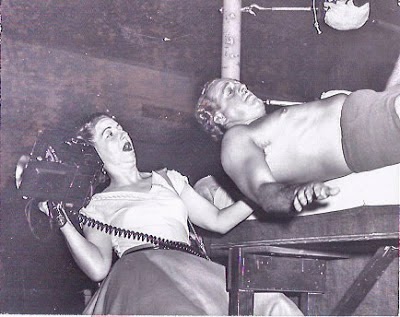
     Obviously the lady knew what she liked.  Getting the close-up action-type shots which she was partially renowned for weren’t without their hazards however, as she recounted in a 1953 article she wrote for the San Francisco Examiner.

     “Most of the pictures are taken at a distance of ten to fifteen feet. I usually sit in the corner of the steps, right up against the ring. The occasionally leads to complications, as in a tag match when the outside partner is standing about six inches in front of me. In leaning over to “tag”, one of those big feet usually whistles back right alongside my ear.

A wrestling photographer has to learn to dodge flying feet and bodies while still sitting down, because the ringside customers frown on any attempt to stand up and block their view.
Lord Blears joins Shirlie at Ringside
     “Once while I was shooting a picture of action taking place in the center of the ring, Sandor Szabo, who was in my corner, felt that the other team was taking an unfair advantage. He jumped in to help his partner without being tagged, but in going over the ropes, his foot ‘tagged’ ME, and I had a black eye for the rest of that week!

     “The next biggest problem is the spectators. They take sides and they threw things, so that you not only have to watch the inside of the ring, but the outside as well.”

     After the Wednesday night matches at the Civic Auditorium Shirlie could often be found at Gleen Neece’s Ringside Bar nearby on First Street along with friends and some of the wrestlers, where many of Shirlie’s photos would grace the walls, for the enjoyment and pleasure of the wrestlers, Glenn Neece and his workers, and any patrons who might have been fortunate enough to have viewed them.

     Shirlie’s amazing work would eventually lead to her being inducted into the Slammers Wrestling Hall of Fame and her original photographs are much sought after by collectors.  Of her work as professional wrestling’s “girl photographer”, Shirlie would say,” It gave me a great experience, and if I may say so, I was quite good.”  An understatement if there ever was one.


More Than a Thousand Words


     A couple of months before this writing, I had been spending about an hour or so on a somewhat leisurely Sunday afternoon leafing through some old wrestling magazines from the 70s.  What had been an hour could’ve easily become several hours as I fondly recalled the first time I had seen the common advertisements in these magazines.  How many times as a kid had I considered sending away for “Sea Monkeys” or the correspondence course which could make me a “Master of Kung-Fu”, or wondered if learning how to customize a van with shag carpet might be a useful skill to have, or wondered what were “the secrets for picking up 1000’s of Women?”

     While I would outgrow the desire to send away for such things or the wonder that a “Love Doll” could really look so life-like, I still got a kick out of looking at the ads and what I had clearly not outgrown was the child-like wonder I felt while looking at the pictures in the wrestling magazines.  They, along with the ads in the magazine and the fictitious stories which accompanied the wrestling pictures, took me back to an amazing, much simpler time.  A time when kayfabe along with the performance of the wrestlers and the promotion and production of the live wrestling events and television wrestling shows made possible the suspension of disbelief.  It was those things that made professional wrestling so amazingly great during the territory days and with so much of the videotape from such days being lost to us forever, the wrestling magazines from that time are for many people an important way to recapture those great times.

     For they bring back not only memories of what wrestling was like, but what life was like.  They help bring back a flood of memories of the wrestlers we watched, the angles we enjoyed, and the people we enjoyed such spectacles with.  They brought back memories of the music we enjoyed, the clothes we wore, the other television shows we watched, who our best friends were, what our preoccupations were, what we dreamed, who and what we loved, who we were, and who we aspired to be.  And it’s not so much a longing to live in the past as it is to relive the things that made us smile, that perhaps provided a bit of escapism for us at one time.  And I challenge anyone to relive in their minds something that once made us smile and see if we don’t find ourselves smiling in the present moment.  And who could ever get enough of that?

     And some of the photos which entranced me the most as I was leafing through those magazines a couple of months back, were the ones taken by Larry Barnhizer of Modesto.  The Uptown Arena in Modesto was an iconic venue for many years in Northern California, with the city itself hosting wrestling since at least the early 1900s.  And with the California wrestling territory, particularly the Northern section, never getting the type of coverage in the East Coast based wrestling magazines; it was most definitely a treat to view and get lost in Larry’s distinct photos along with the accompanying correspondence report.

     And I began to notice that in the early-mid 70s, whenever there was coverage provided of Northern California in the wrestling mags, it was usually provided by Larry.  I thought I just had to get a hold of Mr. Barnhizer to tell him how much I appreciated his work and if it was possible to use some of his amazing photos in my book on Professional Wrestling in Northern California.  I found Larry to be a very enjoyable person in addition to being an amazing photographer.

     Spending most of his life growing up in Riverbank, California and Modesto, ironically enough, Larry’s first live pro wrestling event in the Northern part of the state may have been one being photographed by Shirlie Montgomery.

     “The first live match I saw in Northern California was in San Jose, at a card that featured the Sharpe Brothers, Leo Nomellini, and Bobo Brazil.  I’ve always had an innate love of the sport I guess.”

     His family had moved around a bit while growing up (“We were almost like gypsies,” Larry said with a laugh) and it was in the late 60s when he met Modesto wrestling promoter and policeman Johnny Miller when Miller was visiting some friends who lived in the same apartment complex in Modesto where Larry was staying.

     We got to talking and he invited me to see the matches he was promoting at the Uptown Arena in Modesto,” remembers Larry.

     “I went and I really enjoyed myself but I didn’t go too often for the first couple of years, but Johnny and I became friends and he told me I should come to the matches more often. And it was in around 1970 that I started going more often and I also began sending in match results and articles from the local events to some of the wrestling magazines back east.”

     After a while Larry would buy his first camera and took it with him to the Uptown Arena on particular Friday night.  The move didn’t escape the notice of promoter Miller. 

     “I would get my first camera in 1973 and I took it with me to the Uptown Arena with me and when Johnny saw it, he asked, ‘What are you going to do with it?’ ‘Well’, I said, ‘I thought I’d take some pictures and send them in to the wrestling magazines and see if maybe they’ll publish them.’

     “Johnny looked at me and said, ‘Why not? It couldn’t hurt. Do it and we’ll see what happens.’”

     At first, not much happened as the editors of the wrestling magazines wanted something different than what Larry was turning in, and they asked him for more action shots rather than wrestlers standing near the corner.

     “It was very, very hard,” remembers Larry. “It took me about six months of shooting before they liked my pictures. Editors wanted different types of moves, the choke hold, body slams, and flying-ariel attacks. I would look at the various pictures and say, ‘how can I improve them next time?”

     But improve on them he did, and the Northern California wrestling fans that saw his work in popular magazines like Wrestling Revue, Inside Wrestling, The Wrestler, the Big Book of Wrestling, and Wrestling Monthly were soon coming up to Larry and telling him how much they enjoyed his wrestling articles.  The 1974 issue of Wrestling Round Up had a feature presentation of about a dozen of Larry’s pictures in what they dubbed Larry Barnhizer’s Scrapbook.  Larry’s name was placed on the cover of the issue which is a virtually unheard of experience for a pro wrestling photographer. 

     “One year, Bill Apter ran my photo of Kurt Von Brauner choking Moon Dog Mayne in a 1975 issue of The Wrestler and picked it as one of the 8 best photos of the year.”

     And Johnny Miller, who was sometimes featured in some of the articles was enjoying the increased recognition as well, beaming when fans came up to him and recognized him from the pictures and articles Larry got published in the wrestling magazines. Larry remembers with a laugh that one particular profile he did on Miller got the promoter so excited, “that he had someone drive him around all over Modesto so he pick up all the copies he could find!”

     In addition to shooting photos at Modesto, he’d also capture the fast and furious action taking place at other venues, such as Sacramento and Stockton. But it was the Uptown Arena, the converted 2nd floor warehouse with it’s distinctive exposed overhead rafters and wooden beams that would be his main stomping grounds and it was the photos that he took and the articles he wrote covering the wrestling action there that gained him the most recognition. At times, his coverage of the wrestling cards he shot photos at and did write-ups on might be the only ones representing the Northern California wrestling circuit in a given month. And without the TV publicity that larger cities like San Francisco and Sacramento would get, the added publicity that Johnny Miller’s cards received due to Larry’s work was a blessing.

     Eventually Johnny Miller would discontinue promoting wrestling in Modesto in 1979, and although it was the end of an era, Larry’s career as a wrestling photographer would continue, as he would later photograph events for promoters Red Bastien, Antone Leone, Leo Nomellini, and Roland Alexander.

     One of his most cherished photos is one he took of Hulk Hogan and Nick Bockwinkel at the Oakland Coliseum in 1982 at an AWA event promoted by Leo Nomellini.  The shot would be featured in an article in the September 1982 edition of the Wrestler entitled “Bedlam in the Bay”.  The picture was blown up to a two page spread, and one would be hard pressed to remember many occasions where that occurred in a wrestling magazine.

Larry Barnhizer presents Smirnoff with an Award
 
     “I had to run around the ring to catch that photo and snapped the shot as soon as I came to a stop,” says Larry. “I wasn’t sure if it’d come out right, but it did. Later when the magazine came out, I was standing with Leo Nomellini when Hulk Hogan walked by and Leo shouted out, ‘Hey, Hulk, this is the guy that took that picture of you!’ Hogan gave me a smile and a ‘thumbs up’ and said, ‘Thanks man.’”  Sometimes like Shirlie Montgomery he got a little too close to the action, such as when his camera got kicked into his face while shooting a six-man tag match involving the Von Steigers.

     “A foot caught my camera and smashed it against my face.  It hurt and cut me up pretty good.  I was so mad.”

     But in all, Larry had no regrets about the time and effort his put in as a professional wrestling photographer for over 30 years. 

     “I came along and wrestling started to really grow in Modesto and Stockton, and I owe a lot to Johnnie Miller, who really encouraged me.  Before, Modesto was just a forgotten town.       

     “It’s been an exciting and terrific saga and I admit to still being thrilled when people like editor Reg Noble say, “Larry Barnhizer’s photos are worth more than a thousand words!”  But mostly I want to be remembered for giving Professional wrestling in Northern California an extra boost by the thousands of pictures I’ve taken.” – RR


In addition to my personal conversations with Larry Barnhizer, the following sources were used for this article:


“San Jose native, Shirlie Montgomery dies at 94”, by Mary Gottschalk, San Jose Mercury News, November 11, 2012 

“Photography: Subjects Land Atop the Camera, by Shirley Montgomery, August 2, 1953, “Shirlie Montgomery: Girl Photographer”, by Bob Bortfeld, August 11, 2013

Shirley Montgomery Obituary by Joe Holt

 “Mantecan boosts pro wrestling with photos, articles”, The Manteca Bulletin, by Matt Miller, January 21, 1990

Manteca resident focuses on wrestling”, by Paul Burgarino, Staff Writer, The Oakland Tribune, November 25, 2007

“Molding His Image With a Camera”, by Ucilia Wang, August 3, 1996, Recordnet.com Photographer captures wrestling at its toughest, by John Branch, Editor, The Riverbank News, August 15, 2001


Monday, September 23, 2013

MY FIRST TIME By Rock Rims


   Do you remember your first time?  Was it in an intimate setting with just you and a single partner, or did a whole group get involved?  Was there lots of sweating, lots of grunting and groaning?  Was it everything you expected?  Did it leave you wanting to come back for more?

   I can distinctly remember my first time.  I was just 3 years old.  Yeah, that’s right.  We got started early in my family.  I was 3 years old the first time I attended a live wrestling event and it definitely left me wanting to go back for more.

   I was living in East Los Angeles and I remember how excited I was that night in 1971, and my adrenaline was flowing not just from the anticipation of the upcoming live wrestling event, but because it seemed like my Stepfather and I were in danger of being late for the start of the event.  I can remember my Stepfather hopping our back fence so that we could take a shortcut to the bus stop and my Mother trying her best to help me up the side of the chain link fence so that my Stepfather could pull me over the other side.  We then crossed the huge dirt lot that was part of our neighbor’s property, a lot that would become bigger still in about a year when their house burned down.  I must have been a little bit of a sadist as a kid because I remember as the whole neighbor watched that family’s house burn to the ground; my very young uncle and I were munching on popcorn as we watched the blaze.

   My Stepfather and I had managed to catch the bus that would take us to the wrestling venue, and I would stare out the window of the bus at the lights of the city, with wonder as they contrasted with the darkness of the night while also trying to imagine what it might be like when we arrived at our destination.  Finally we had arrived at the historic Olympic Auditorium on 18th and Grand in Downtown Los Angeles.  We finally took our seats which between the fact that they were probably fairly high up in what was a packed house, and the fact that I was only a little kid, made the ring seem as if it were a world away.  I could see cigarette hovering above the ring and I stared in wonder at the men with funny little red and white striped paper hats who with unerring and amazing accuracy, could toss a bag of peanuts to the waiting hands of anyone, regardless of how far away they were.

   I slowly ate my bag of roasted peanuts while watching the wrestling matches, and I wish I could tell you who wrestled in those matches prior to the main event or even on what exact date the event took place.  But those facts escape me.  What doesn’t escape me was the fact that the main event was something I knew was of great importance.  I don’t remember what events, what angles had led up to this particular event, but I knew that it meant something.  For in the main event, the bitterest of enemies in Southern California wrestling, not only at that time, but perhaps in all of Southern California wrestling, were about to engage in a war.  And “Maniac” John Tolos and Freddie Blassie didn’t disappoint.

   What I can also tell you is that I was in the minority.  I wasn’t in the minority because I was a Mexican-American, hell, in the Olympic Auditorium you were probably in the minority if you weren’t.  I was in the minority because I was there to root for John Tolos.  Blame it on my upbringing if you will, but this 3 year old would be cheering for a man nicknamed “Maniac.”  John Tolos was the most hated wrestler in Los Angeles at this time and was the definite “heel” or “bad guy” in this feud that had stretched back to the summer of the previous year. By contrast, Freddie Blassie with his sequined and colorful outfits, sometimes accessorized with a sombrero, had definitely endeared himself to the hearts of the fans, many of whom were Latinos.

   Finally the main event began and a chill ran down my spine as the combatants were introduced.  And the match did not disappoint.  It was a melodrama, and being seated so far from the ring, the epic battle was almost a pantomime of sorts, with the only audible sounds or soundtrack being the screaming of the fans.  The match consisted of peaks and valleys and I sat with my eyes and attention riveted to the moral play unfolding in the ring.  There was blood…lots of blood…and I remember having to fight off breaking into tears as I saw Freddie Blassie bite into the head of my then-hero John Tolos. 

   If I remember correctly, Blassie won that match, much to my disappointment.  However to my delight, Tolos would return to fight another day.  Their feud would become the stuff of legend, and all throughout their 4 four years of battling off and on, they’d participate in every conceivable type of match against each other, including stretcher matches, cage matches, matches involving brass knuckles, chain matches, and “Gladiator Death matches.”  They would even return many years later in 1980 to square off in a tag team cage match.  Blassie would be in his early 60’s in this one and while the match was hardly a classic and the arena was less than half full, the “pop” they got from the crowd made it seem as if there were many more in the crowd than there actually was.

   The first wrestling “maneuver” that I ever learned was the “corkscrew” that John Tolos used on the temples of his opponents head.  My stepfather was gracious enough to demonstrate it’s effectiveness on me and I in turn couldn’t wait to show my brother how effective it was in producing a headache. 

   But why did a 3 year cheer for such a hated guy like John Tolos?  I guess I didn’t know any better.  On the other hand, I think I did.  Tolos was compelling, magnetic, and both his presence in the ring as well as his unique and intense interviews made you want to watch his every move, hang on his every word.  While the goal of Tolos and the storylines may have been to make the fans hate him, more importantly, the goal was to get us to watch him.  And watch him we did, he and Blassie both.  That year in 1971, the two would meet at the Los Angeles Coliseum in August and set what was then a record gate for a wrestling event as 25,847 fans paid $142,158.50 to watch Blassie defeat Tolos 2 falls to one in their “battle of the century”.

   And as a whole, pro wrestling itself was still very compelling at that time.  Even if we had the technology available back then, I guarantee you that no one would have been sending or checking their text messages or updating their facebook status.  For the only status they were concerned about was what was going on in a 20 x 20 foot ring and the only world they knew for 2 hours or so was the world within that arena.  And just as the world outside the wrestling arenas have changed so have the worlds inside them.  - RR

Saturday, September 7, 2013

THE GENIUS GETS A PARTNER- By Rock Rims


     “You look like shit.  Do you ever work out?”  Not exactly the kind of greeting an incoming wrestler hopes to hear from his new boss but it was exactly what Pat Patterson got from Roy Shire when he arrived in Northern California in 1965.  By this time Ray Stevens had already established himself as the “Golden Goose”, the top heel of the “Big Time Wrestling” promotion in Northern California.  He could always provide a reason for the fans to lay down their hard earned money in hopes of finally seeing him go down in defeat.

   And now a 24 year old  Patterson who had been wrestling for about 7 years including the last few years in Don Owen’s Pacific Northwest territory, and had in the span of 2 months had lost a hair match, his Pacific Northwest heavyweight title, and a “Loser Leave Town” match, had  come to town looking to gain something.  Only at first, he didn’t get what he was looking for. 

    Before working his first show Patterson had written Shire, requesting to be paired up with Ray Stevens, saying that many in-the-know in Portland felt that with their similar styles, they’d make a great pairing.  Patterson would later say that Shire didn’t give him the response that he’d been hoping for, and besides the critique regarding physique Patterson would also recall:  “He said, ‘The boys don’t make the decisions here, I make the decisions.’  Roy Shire was very hard to work for.”

     As it turned out, Stevens had just left to work an extended tour of Australia just before Pat had arrived, so initially Pat was working in some singles as well as being paired with Dan Manoukian in a tag team.  Manoukian had previously been ½ of the World tag team champions with Stevens before losing it in a “Phantom change” to Billy Red Lyons and the Destroyer on March 1985.  3 months after Pat’s arrival, Roy relented, telling Patterson to dye his hair as the new tag team of Patterson and Stevens was to be known as “The Blond Bombers.”   Longtime wrestling fan Robert Counts lived near the Cow Palace and remembers “In a promo Patterson had dark hair and was bragging about what he was going to do to Stevens and the next week his hair was blond and he was teaming up with Stevens.”  The team didn’t waste any time in making an impact as they quickly won the A.W.A. (not Verne Gagne’s group) World Tag Team titles on April 17, 1965 from Billy Red Lyons and The Destroyer and would hold the titles for an astounding 623 straight days.

   It was a dynamite combination and a match made in heaven as the “Blonde Bombers” were exciting to watch, whether you were rooting for them or against them.  They were masters of their craft who were willing to sell for their opponents and take big bumps, and they combined these assets with great ring psychology and promos that would both insult and incite the local fans, putting butts in seats time and time again.  The compelling, logical, and realistic storylines that promoter Roy Shire devised in combination with the realism with which Patterson and Stevens performed in the ring just sucked the fans in and still brings smiles to their faces decades later.

   “They got heat.  They got natural heat.  They could work with anybody,” said Red Bastien.  And they worked with quite a few tag teams during that first run as the tag champs including Kinji Shibuya and Mitsu Arakawa, as well as against old Stevens’s foe Pepper Gomez and numerous different partners he would pair with.  Their ability to draw didn’t confine them to Northern California either as they would occasionally go on the road to defend their tag titles in such places as Hawaii, Phoenix, and the Pacific Northwest.

   The working arrangement between Pacific Northwest promoter Don Owen and Northern California promoter Roy Shire not only allowed for Patterson and Stevens to defend their World tag team titles but also allowed Pat to challenge Gene Kiniski for the NWA World Heavyweight title in Portland, Oregon on December 2, 1966.  Indeed, it was a safe bet that Shire no loner felt that Pat looked like “shit”.  Also during that December tour of the Pacific Northwest Pat would regain the Pacific Northwest Heavyweight title by beating Tony Borne.  It was the belt he had lost shortly before leaving Portland 2 years before.  It didn’t last long of course as Pat would drop the belt back to Borne 9 days later on December 18th, and the Blonde Bombers were soon back in San Francisco.

   Not long after the arrived back in Northern California Ray and Pat would lose their belts to two very tough customers in the team of Cyclone Negro and the Mongolian Stomper at the San Francisco Cow Palace on New Year Eve.  Negro and the Stomper were merely keeping the belts warm for them however as they made short work of them in the rematch 3 weeks later at the Cow Palace’s first show of the New Year on January 21, 1967, winning 2 out of the 3 falls in less than 16 minutes.

   Their second reign as champs didn’t last nearly as long as the first one however as  the all time best draw in San Francisco, Ray Stevens was needed back in singles. He would recapture the U.S. Heavyweight title from Bill Watts in March and at the next Cow Palace show on April the 8th, The Bombers dropped the tag belts to the popular team of Pedro Morales and Pepper Gomez.  Ray and Pat would still team together on occasion but Roy Shire may also have felt that the team was getting a bit stale in the eyes of the fans and Pat was wrestling more singles as well.

   For most of 1968 Pat Patterson was doing tours in Australia and Japan as well as having a run for several months in Amarillo where he suddenly had become a "Lord".  He would return to Northern California in 1969 only to find that his old partner Stevens had a change of heart and was now wrestling as a “good guy.”  It was quite the shock for Patterson as wrestling fan and announcer Joe Sousa recalls: “When Pat came back he wanted to resume teaming with Stevens but he couldn’t believe what he was hearing about Ray and said, ‘I don’t know what’s got into the guy and why he’s acting like a sissy!  I’m going to have to knock some sense into the guy!”

  Patterson didn’t have to wait long as the two would begin facing each other in the ring at the end of February in a heated feud that would continue for over 2 years.  Whether it was in singles matches or tag matches, matches for the U.S. title or for the World Tag Team titles, non-title matches or Death matches, it was a rivalry that kept fans gravitated throughout Northern California, Reno, Nevada, and even Hawaii.  It involved two master psychologists and workers in the ring, and it captivated the imaginations of those who witnessed their battles.

   “I was extremely lucky to have seen both of their careers in the Bay area from start to finish and it would do extreme injustice to pick one over the other” say Les Puskas, a lifelong wrestling fan who deals in Northern California wrestling memorabilia.  “They were both naturals.  Together they had chemistry like no other.  They were simply artists in action and against each other it was like 2 dancers at the top of their routine.  Patterson was lucky enough to be able to learn things from Stevens but Stevens was also lucky enough to learn from Patterson.  Honestly, I do not know if I would have been so obsessed with the sport had it not been for both of them.”

   Whether they worked as partners or as opponents, the two had a great mutual respect for each other and as Pat would later say regarding working with Stevens, “In the ring, he was a master, no question about it.  I learned a lot from him.  And I learned a lot from Roy Shire.”  

   Superstar Billy Graham had come in from Los Angeles in October of 1970 and had been paired with Patterson so that he could learn from a master worker and psychologist.  He also took part in the Patterson/Stevens feud and learned from them both, referring to his time in San Francisco as earning his degree in “mark psychology.”  He had the utmost respect for the work of his tag partner Patterson and expressed some of those sentiments in his autobiography “Tangled Ropes”.

     “He was a flawless heel, vicious, and aggressive, and did everything with precise timing.  To this day, there’s never been anybody who can throw better mounted punches from the ropes.  When his head ran into the ring post, it recoiled, with hair flying backward, like it was about to pop off.” 


   Eventually the feud would come to an end as Ray would head to the Midwest to work for Verne Gagne’s AWA, although he’d return a few times to resume the feud.  In the end he and Pat would kiss and make up before Pat would eventually join him in the AWA.  But before that happened, Patterson would enjoy the “single life” as he held the U.S. Heavyweight title a half dozen times in Roy Shire’s territory, and was involved in memorable feuds with Rocky Johnson, “Moondog” Lonnie Mayne, Mr. Fuji, and “The Great Mephisto” Frankie Caine.  It was that feud with Caine that made Rod Higashino a lifelong fan of both Pat Patterson and classic pro wrestling.

   “(Patterson) was part of the defining moment for me becoming a full blown wrestling fan.  As a little kid I remember being at my neighbor’s house while they were watching 'Big Time Wrestling' and they explained to me who were the ‘good guys’ and the ‘bad guys’”.  Rod became frustrated as he saw top heel and current U.S. champ “The Great Mephisto” win week after week with his “loaded” boot.

   “He never did lose, but one week on TV Patterson attacked him, body slammed him on the ‘hard, concrete floor’, as announcer Hank Renner would always call it, and jumped off the ring apron with a ‘Bombs Away’ to Mephisto’s throat.  As I sat there mesmerized, Patterson began unlacing Mephisto’s ‘loaded’ boot and eventually took off with it!  Mephisto came out complaining that one of his legs was shorter than the other and without his special boot he would lose his equilibrium.  Patterson came out saying that his leg had been a little sore lately and if his leg hurt before a match with Mephisto, he would wear the boot.  That was it- I was hooked!  That was the angle that got me watching each and every week and made Patterson my 'all time favorite'”.

   While they made a great team and Patterson had learned much from Ray Stevens, he would continue to develop and perfect his craft and identity on his own.  In 1977 he would be involved in the “Masked Fuji” fiasco before having his final run in the early part of the years as the U.S. champ, after winning a tournament.  He would defend that belt in Northern California, wrestle a couple of shots in both L.A. and New York, and then finish out the year in Florida.  After over a dozen years working for Roy Shire, much longer than he expected, Pat Patterson would find himself in Verne Gagne’s AWA.

   His appeal was so vast, his talent so immensely appreciated by fans and promoters alike, that after a year and a half, he would find himself splitting time between Gagne’s AWA and Vince McMahon Sr.’s WWF.  On June 19, 1979 he would beat Ted DiBiase for the WWF North American Heavyweight title, which would soon morph into the WWF Intercontinental title, while simultaneously holding the AWA World tag team titles with Ray Stevens.  While they would lose the belts 9 days after Patterson’s North American title win, he would continue as a singles champion in the WWF and was a top challenger for Bob Backlund’s WWF Heavyweight title.  He was even awarded the NWA America’s title after a fictitious match in Hawaii before defending and losing the title against Chavo Guerrero in Los Angeles on November 16th.  Such was his credibility as a champion.

   For the next few years he would split time between the WWF and the AWA.  Pat Patterson was such a hot commodity that the promoters were willing to share, and to an extent that was very rare, especially considering that the WWF was on the cusp of it’s nationwide expansion.  Before their expansion however, the AWA was doing some expanding itself and would begin running shows in Patterson’s old stomping grounds, as Roy Shire’s Northern California promotion was getting ready to fold.

   On January 15, 1981, Pat would team up with old partner Stevens to beat Adrian Adonis and Jesse Ventura on a wrestling card that Verne Gagne held at the Oakland Coliseum.  The man who had settled down in San Francisco would return one more time for Roy Shire however, as he would participate in and win the 1981 San Francisco Battle Royal on January 24, 1981.  He would also beat NWA World Champion Harley Race by count out on what was to be Roy Shire’s last wrestling card.

      Patterson, who at one time helped Shire with booking his territory, had developed into one of the greatest minds in wrestling.  This would not only benefit his career, but would contribute greatly to Pro Wrestling entertainment as he would go on to be a key figure behind the scenes in the WWE for many years, helping greatly to develop compelling angles and finishes. 

   On May 27, 2013 The WWE was in Calgary, Alberta, Canada for a taping of their flagship television show “RAW” and what was to be “The Bret Hart Appreciation Night”.  Many current and former prominent Canadian wrestlers were on hand to pay tribute to the worthy 5 time former WWE Champion and pro wrestling legend.  Foremost among them was Pat Patterson, who referred to Bret as “The greatest Canadian of all time.”  While perhaps no one would argue that Hart was deserving of the tribute and recognition, some might contend that Pat himself was in fact the greatest Canadian, or at the very least, “The Greatest Canadian Wrestler of all time.”

   Nearly 50 years before (I bet that just made some people feel old) “The Genius” Ray Stevens, received a new partner, a man who would become a genius in his own right, to the delight of all who would watch him. - RR


Special thanks to Rod Higashino, Robert Counts, Joe Sousa, and Les Puskas for sharing their memories of Ray Stevens and Pat Patterson.
 
Les Puskas deals in Classic California Wrestling pictures, programs, and magazines which you can view at Wrestlederbysport.com/ or on Ebay under his seller i.d. of "LPBingo".
 
Sources:
Wrestlingtitles.com
"Pro Wrestling Hall of Fame: The Tag Teams" by Greg Oliver and Steven Johnson

Monday, August 12, 2013

SPREADING THE EXCITEMENT - By Rock Rims


   Just a few years earlier the two men had paired up a few times, partners against common enemies; now they were on opposite sides, both seeking vengeance.  It was November 10, 1973 at the Cow Palace in San Francisco, and Pat Patterson and “Moondog” Lonnie Mayne were set to clash in the main event for Patterson’s United States Heavyweight Wrestling Title.  4 weeks earlier, Mayne had bloodied Pepper Martin for the second time in a matter of weeks and Patterson saved Martin from a more serious beating.  Now he was looking to avenge that beating and Mayne was looking to avenge the interference.  And if he won the U.S. title in the process that would just be the icing on the cake.

   With fans rooting for their hero Patterson to tame the wild Moondog, the two battled fiercely in a match that resulted in a draw, and even when they met again on December 1st, with legendary tough guy Peter Maivia as the special referee, nothing was settled as Moondog Mayne lost the 3rd fall of the rematch on a count out.  The only things that were decided was that Patterson and Mayne wanted another shot at each other and that Maivia had made a new enemy as he and Lonnie had gotten physical during the match up.

   10,000 fans had been treated to an intense back and forth battle and promoter Roy Shire knew he had gold.  3 weeks later the two were matched up yet again, and 12, 517 screaming fans packed the Cow Palace and ponied up $52,006 to watch Moondog Mayne once again challenge the champion.  That was almost twice the audience and gate that had witnessed Dutch Savage do the same thing less than 3 months earlier.  As was expected, the two fought tooth and nail, and to the shock and dismay of those in attendance, Moondog Mayne defeated Patterson in the 2 out of 3 fall event and was the new U.S. Heavyweight champion! 

   There would be rematches with Patterson as well as challenges from other formidable foes such as Don Muraco, Rocky Johnson, and Peter Maivia.  And in the summer of ’74 Moondog would find himself in the position of challenger once again.

The Champ comes to town

   NWA World Heavyweight Champion Jack Brisco was coming to San Francisco for a rare visit and as the U.S. Heavyweight Champion, Lonnie “Moondog” Mayne was the number one contender in the territory.  The two seemed like complete polar opposites in the ring as former NCAA National wrestling champion Brisco relied on his technical wrestling whereas the “Moondog” character that Lonnie Mayne had developed was a fierce brawler, prone to baying like a wild dog and biting into the flesh of his opponents every chance he got.  This would not be the first time or the last that Lonnie Mayne would fight for a World title.  And as he always did, he gave the champ all that he could handle.  Could you imagine the reaction the Cow Palace fans would have, if this dog food eating, glass chewing animal who held the U.S. title would become the World champion as well?  Their hearts must’ve momentarily stopped because it nearly happened!

   Each man had won a fall in the July 27, 1974 title match when Mayne cracked the champion with a devastating punch while wearing brass knuckles!  It went unseen by referee Larry Williams who then delivered the 3 count as Mayne covered Brisco for the pin and it seemed that there was a new champion.  However the Moondog’s victory was short lived as another referee, Frank Nocetti, entered the ring and informed Williams that Mayne had used brass knuckles.  The decision was reversed with Moondog Mayne now being disqualified and Brisco escaping with his title!  Well easy come, easy go.

   Of course this called for a rematch and Shire was willing to give the NWA Champion his typical healthy slice of the gate for their return match 3 weeks later which also saw Brisco leave with his title claim intact.  Well at least Moondog still had his U.S. title belt.  At least for a couple of months anyway as Peter Maivia would win the belt on October 12th.  Rematches in San Francisco, Sacramento, and Las Vegas would ensue, along with a rekindled feud with Pat Patterson which was more hot and heavy than their first time around.

   And in the sometimes strange world of professional wrestling, Lonnie Mayne again displayed some of his versatility as a performer in the summer of ’75 when he not only became a “good guy” but he also began teaming with ex-bitter enemy Pat Patterson and even Pepper Martin himself!  The fans were now rooting enthusiastically for the “Moondog” but this run in San Francisco was quickly coming to its end.


On The Road Again

   After a stopover in Portland it was on to Georgia for Lonnie Mayne where he again “flipped the script” becoming a hated heel, teaming with the likes of “Crazy” Luke Graham and Abdullah the Butcher, and opposing such “fan favorites” as Mr. Wrestling II, Dick Slater, Bob Backlund, Bobo Brazil, and Thunderbolt Patterson.  After 6 months of that it was on to the Lone Star State, where he feuded for several months with Jose Lothario, challenged the America’s Heavyweight Champion Chavo Guerrero in a rare title defense outside of Los Angeles, and won a battle royal. 

   And as if things weren’t interesting enough, as 1976 was drawing to a close, the vicious Moondog again became a fan favorite, just in time to engage in a series of matches against the Sheik in what must’ve been like watching two pit bulls going at it.  Lonnie found a place in the hearts of the Texas Wrestling fans.  It inspired Ricky Ringside to produce a 45 single entitled “The Ballad of Moondog Mayne” which was played during Moondog’s walk to the ring and sold at the arena concession stands, and it caused fans to delight as Mayne stormed the ring dressed as Santa Claus and swung a bag of toys at the heels who made a quick exit.

  Before he left the area in the spring of ’77, Lonnie would wrestle NWA World Champion Terry Funk to a draw and also challenge new champion Harley Race as well.  While he didn’t walk away with the title, he gained many new fans who remember the man for whom “every day is like Christmas” and who seemed at times to be a mischievous butt-kicking version of old St. Nick himself.

 
Did He Really Call You Crazy?

 
   In February of 1967, almost right from the start of Lonnie Mayne’s career in the Pacific Northwest, Ringside commentator Frank Bonnema was right by his side along for the ride.  Bonnema was always the epitome of composure which was in stark contrast to the sometimes chaotic atmosphere which was part of the Portland Wrestling television program.  Shown live beginning at 8:30 p.m. on Saturday nights, Bonnema was a cherished fixture, as much as the salesmen hawking used cars with vinyl seats, mobile homes and recreational vehicles, and appliances from Tom Peterson’s where you could pick up anything from washers and dryers to cb radios and faux wood console stereos complete with AM/FM radio, an 8 track cassette player and flashing disco lights. And Frank and Lonnie seemed to complement each other perfectly.

   Now, it was the spring of 1977, 10 years since they first worked together, and Lonnie Mayne was back in Oregon. With his strong drawing power at the box office and the working relationship between Roy Shire and Don Owen it wasn’t unusual for Lonnie to make an occasional trip to San Francisco while simultaneously working for Don Owen in Oregon.  And with Frank Bonnema holding the microphone, Lonnie was discussing his upcoming match with U.S. Champion Alexis Smirnoff at the Cow Palace in San Francisco.

   “Because all I heard”, Lonnie was saying during his promo, “He said I was crazy and let me you one thing Smirnoff…tonight in the Cow Palace I got a United States Championship match.  I had that before Frank.  I had that belt and tonight I got it again and you know what’s goin?  I’m going to beat him like raw hamburger!”  Lonnie then began eating raw hamburger on camera and then threw some down on the studio floor where he began to stomp it, as if to demonstrate what he would be doing to his opponent.  In mock surprise Bonnema then asked Lonnie, “Did he really say you were crazy?”

   While he never liked to be called “crazy” Lonnie “Moondog” Mayne seemed to do all he could to convince the fans that he was and there was a method to his “madness”, as he could alternately cause his audience to fear and despise him, or embrace him warmly.  And in the Pacific Northwest it was with open arms that he was welcomed back.

   Don Owen’s Pacific Northwest territory was promoted in a way that would appeal to its audience who were mostly comprised of simple, unpretentious, blue collar workers and their families, who had a strong sense of community.  It wasn’t unheard of for Don Owen to offer “specials” where for each paid adult admission a child would get in free or to offer free coloring books to the children for showed up to the arena events.      

    These were wrestling fans that no doubt agreed with the policy of “speak softly and carry a big stick” although those fans could get quite loud and vocal in the Portland Sports Arena and little old ladies were known to substitute a swing of a cane for a big stick.  They boisterously booed the villains and wholeheartedly cheered and embraced their heroes and Lonnie was one of the most popular wrestlers ever in the area.

     This wild looking man who wasn’t always articulate in his interviews but would still leave no doubt as to the point he was making, was a genius at cultivating the love the fans had for him.  He would dedicate his victories to his fans and promise to “do it for the people” and was known to sometimes where t-shirts to the ring that read “Love Oregon or bite me!”  Although his character was simple and sometimes even crude, that wasn’t something that worked against him but rather in his favor.  He spoke much like many in the audience probably did and with the type of dastardly opponents he faced, the fans no doubt felt that someone who was a bit of a roughneck is just who was needed to put the heels in their place.  Ed Wiskowski referred to him as a “blue collar Robin Hood” and that’s exactly how the fans saw him, as there to right the wrongs. 

     He was also a “Pied Piper” as this man who had in years past struck fear in the hearts of ringside fans and had even been billed alternately as “MadDog Mayne”, “Moondog Mayne” and  “Mauler Mayne” in some instances, now had children running up to him to touch him and shake his hand on his way to the ring.  In the Northwest, he was simply known as “Lonnie”.  I can still recall the image of him soundly thrashing Buddy Rose and tenaciously chasing him around the ring, only to soon after have a girl around the age of 5 run up and give him a hug.  He would then lift the child in his arms and walk with her up the aisle to the applause and smiles of those in attendance.  He was that crazy but loveable uncle, Santa Claus with a couple of shots of Southern comfort in him to keep himself warm on a cold Christmas Eve.  It was a testament not only to his appeal with the fans but to his tremendous versatility as a performer.  – RR


Next:  Saying Good bye to Lonnie            
 
Special thanks to Doug McCleer for sharing some of his photos for this article.  
 
Top photo by Viktor Berry       


Sources:

Wrestlingdata.com